Black White 3d Line Illusion Distortion: A Practical Guide to Monochrome Geometric Art
The visual landscape of modern design is constantly evolving, yet certain aesthetic principles remain timeless. Among these, the Black White 3d line illusion distortion stands out as a powerful tool for creating depth, movement, and intrigue without relying on color. This specific style leverages high-contrast monochrome palettes and geometric manipulation to trick the human eye, resulting in designs that appear to shift or warp when viewed from different angles. For professionals ranging from interior designers to graphic artists, understanding the mechanics and applications of this style is essential for making informed creative decisions.
This article explores the distinct characteristics of black white 3d line distortion illusion design, evaluates its utility across various mediums, and compares it with alternative artistic approaches. Whether you are selecting assets for a large-scale banner or a detailed clothing print, knowing the strengths and limitations of vector-based optical illusions can significantly impact your final output.
Understanding the Mechanics of Optical Distortion
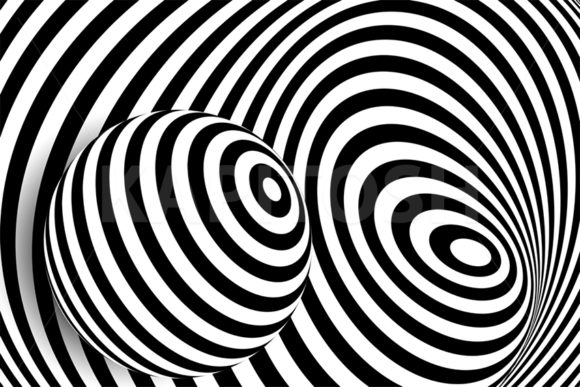
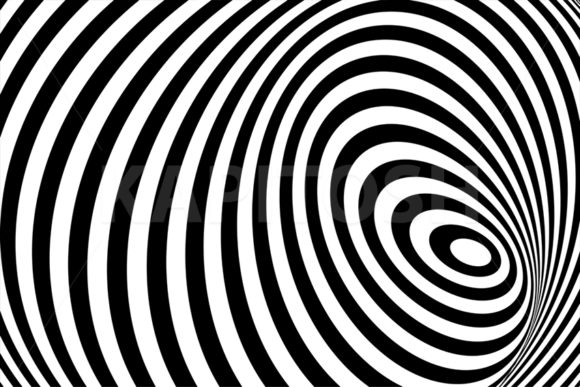
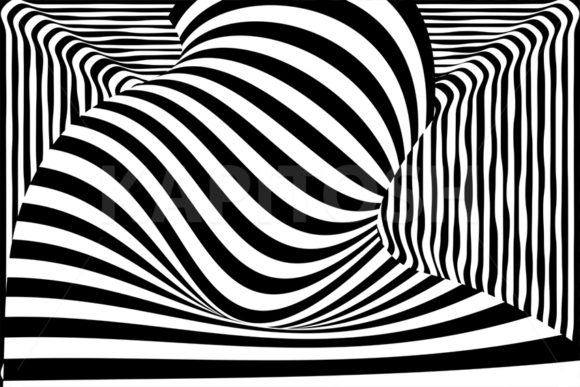
At its core, black white 3d line illusion distortion relies on the interplay between negative space and positive form. By utilizing a vector monochrome background, designers create a stark contrast that emphasizes the geometry of the image. The technique often involves geometric stripped pattern illustration art, where lines are arranged in rhythmic sequences that curve, twist, or converge to simulate three-dimensional volume on a two-dimensional plane.
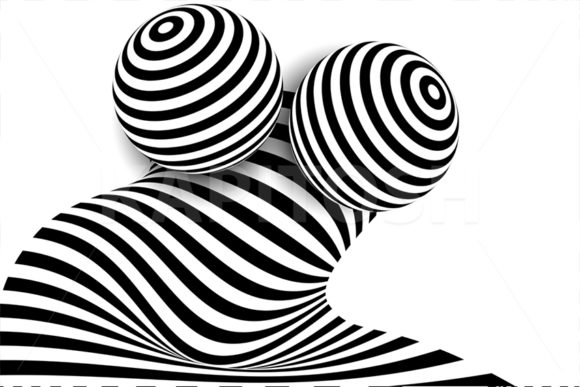
A key component of this style is the modern swirl curve tunnel cover. These elements guide the viewer's eye through the composition, creating a sense of forward momentum or infinite depth. When combined with ball circle shape motifs, the design gains a focal point that anchors the chaotic energy of the surrounding lines. The result is a dynamic visual experience that feels alive, even though the artwork itself is static.
The use of vector files is critical here. Unlike raster images, which can lose quality when scaled, vector illustrations maintain their crisp edges regardless of size. This ensures that the precise mathematical curves required for the illusion remain sharp, whether the design is reduced to a small sticker or expanded to cover an entire building facade.
Comparing Vector Precision with Raster Alternatives
When evaluating options for black white 3d line distortion illusion design, one must consider the file format and the software environment. The primary advantage of the vector approach found in EPS files is scalability. In many professional workflows, designers work within Adobe programs such as Illustrator, Photoshop, and InDesign. While Photoshop (a raster-based program) can handle these images, the native vector format allows for non-destructive editing in Illustrator.
Strengths of Vector-Based Illusions:
- Infinite Scalability: The design can be resized from a business card to a billboard without pixelation or loss of detail.
- Editability: Individual paths and curves can be adjusted to fine-tune the distortion effect without degrading the image quality.
- File Size Efficiency: Vector files are generally smaller than high-resolution raster equivalents, making them easier to store and transfer.
Limitations Compared to Raster:
While vectors excel in line precision, they may lack the organic texture or complex shading gradients that a high-resolution JPEG might offer. If a project requires a photographically realistic texture overlay, a pure vector approach might feel too sterile. However, for the specific goal of creating a clean, optical illusion, the vector format is superior.
For users working with CS5-CC versions of Adobe software, compatibility is rarely an issue. Most modern design suites support both EPS and high-resolution JPEG formats seamlessly. The inclusion of a 300 dpi JPEG in the asset batch provides a fallback option for users who need a quick preview or require a rasterized version for web use, while the EPS file remains the master source for production.
Evaluating Use Cases Across Industries
The versatility of black white 3d line illusion distortion makes it suitable for a wide array of applications. Its monochromatic nature ensures it integrates easily into diverse brand identities without clashing with existing color schemes. Below are specific scenarios where this design style excels.
Interior Design and Architectural Visualization
In interior design, wall murals and feature panels often benefit from the modern swirl curve tunnel cover aesthetic. The illusion of depth can make a small room appear larger or add a futuristic touch to a minimalist office. Because the design is black and white, it does not overwhelm the space, allowing furniture and lighting to take center stage while providing a sophisticated backdrop.
Advertising and Large Format Printing
Banners and posters require graphics that capture attention from a distance. The high contrast of the black white 3d line distortion illusion design creates immediate visual interest. When printed on large formats, the geometric stripped pattern illustration art maintains its integrity, ensuring that the optical effect remains visible even when viewed from several meters away. This makes it ideal for trade show displays or outdoor advertising campaigns.
Apparel and Merchandise
Printing on clothing presents unique challenges regarding fabric texture and ink coverage. Vector files are particularly advantageous here because they allow for precise separation of colors (even if it is just black ink). The design works exceptionally well for t-shirts, tote bags, and stickers. The bold lines stand out against fabric textures, and the monochrome palette appeals to a broad demographic looking for contemporary streetwear aesthetics.
Decision Factors: When to Choose This Style
Selecting the right design asset depends heavily on the specific goals of the project. While black white 3d line illusion distortion is highly effective, it is not the universal solution for every design challenge. Understanding the tradeoffs helps in making the right choice.
Choose This Design When:
- You Need Versatility: If the same asset needs to be used across multiple media types (e.g., a website header and a physical poster), the vector format offers the necessary flexibility.
- Brand Identity is Minimalist: If the client or project favors a sleek, modern, or industrial look, the monochrome palette aligns perfectly with those aesthetics.
- Visual Movement is Required: If the goal is to convey speed, technology, or complexity without using motion graphics, the optical illusion provides a static way to achieve that feeling.
Consider Alternatives When:
If the project demands a warm, emotional connection, a strictly black and white geometric design might feel cold or clinical. In cases where organic shapes or hand-drawn textures are preferred to evoke a human touch, a vector illustration might feel too rigid. Additionally, if the budget is extremely tight and no editing is required, a pre-made raster image might suffice, though it lacks the future-proofing of a vector file.
Navigating Technical Requirements and Workflow
For designers integrating black white 3d line distortion illusion design into their workflow, technical proficiency is key. The availability of both an EPS vector file and a high-resolution JPEG (300 dpi) caters to different stages of production. The JPEG is excellent for rapid prototyping or embedding directly into documents where vector editing is not immediately necessary.
However, for final production—especially for printing—the EPS file should be the primary asset. Working in Adobe Illustrator allows for the adjustment of stroke weights, curve adjustments, and the isolation of specific elements like the ball circle shape. This level of control ensures that the distortion effect is optimized for the specific output device, whether it is a digital screen or a commercial offset printer.
Compatibility with older software versions (CS5) ensures that the asset remains accessible to a wider range of professionals, including freelancers or agencies that have not yet upgraded to the latest Creative Cloud subscription models. This backward compatibility is a significant practical benefit, reducing the risk of file corruption or formatting errors during the transfer process.
Conclusion on Visual Impact and Utility
The black white 3d line illusion distortion represents a convergence of mathematical precision and artistic expression. By manipulating simple geometric forms into complex optical patterns, designers can create visuals that are both striking and functional. Its suitability for interior design, advertising, and merchandise underscores its value as a versatile resource.
Ultimately, the decision to use this style should be driven by the need for high-contrast, scalable, and modern imagery. While it competes with other styles that rely on color photography or organic illustration, its unique ability to create depth through line work gives it a distinct place in the design toolkit. For professionals seeking a reliable, high-quality asset that bridges the gap between abstract art and practical application, this vector illustration offers a robust foundation for creative projects.